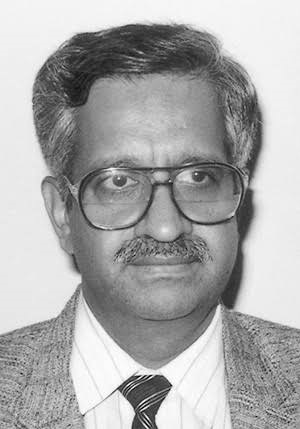
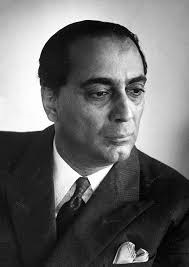
Introduction
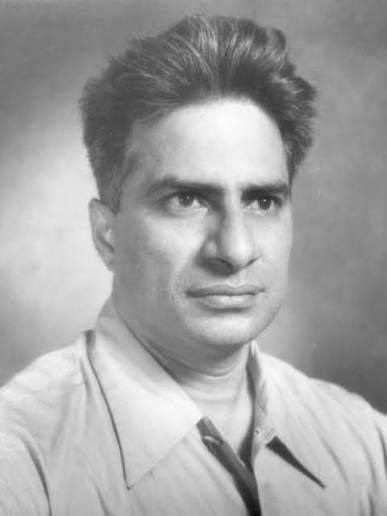
Homi Jehangir Bhabha was one of India’s most influential scientists and is widely regarded as the “Father of the Indian Nuclear Program.” A distinguished nuclear physicist, Bhabha played a pivotal role in establishing India’s scientific and technological infrastructure after independence. His pioneering research in nuclear physics and cosmic rays, combined with his visionary leadership, laid the foundation for India’s atomic energy program. Through his efforts, India emerged as a significant force in nuclear science and research.
Early Life and Education
Homi Jehangir Bhabha was born on 30 October 1909 in Mumbai into a prominent Parsi family. His father, Jehangir Hormusji Bhabha, was a well-known lawyer, and the family had strong connections with India’s industrial and educational circles.
Bhabha received his early education at the Cathedral and John Connon School in Mumbai. In 1927, he moved to England and enrolled at University of Cambridge, where he studied engineering at Gonville and Caius College. Although his family initially wanted him to become an engineer, Bhabha’s passion for physics led him to pursue theoretical physics.
He earned a degree in mechanical engineering before shifting his focus to physics, where he quickly established himself as a talented researcher.
Scientific Career & Research
During the 1930s, Bhabha conducted groundbreaking research in theoretical physics at Cambridge. His work focused on cosmic rays, particle interactions, and quantum electrodynamics.
With the outbreak of World War II, Bhabha returned to India in 1939 and joined the Indian Institute of Science, where he worked under Nobel laureate C. V. Raman.
Recognizing the importance of advanced scientific research, Bhabha founded the Tata Institute of Fundamental Research in 1945 with support from the Tata Trusts. TIFR became India’s premier center for scientific research.
In 1948, he became the first chairman of the Atomic Energy Commission of India. Under his leadership, India began developing nuclear reactors, research facilities, and scientific expertise necessary for peaceful nuclear applications.
Major Discoveries and Inventions
1. Bhabha Scattering
One of Bhabha’s most significant scientific contributions was the theoretical explanation of electron-positron interactions, now known as Bhabha Scattering.
This work became fundamental in:
- Quantum electrodynamics
- Particle physics
- High-energy physics experiments
- Modern particle accelerators
2. Cosmic Ray Research
Bhabha made pioneering contributions to understanding cosmic rays and particle showers produced when high-energy particles enter Earth’s atmosphere.
His studies helped explain:
- Cosmic ray cascades
- Elementary particle interactions
- High-energy radiation phenomena
3. Prediction of Heavy Electrons
Bhabha proposed the existence of particles heavier than electrons before they were experimentally confirmed. His theoretical insights contributed to the later discovery of muons and other subatomic particles.
4. Development of India’s Nuclear Program
Although not an invention in the conventional sense, Bhabha’s greatest achievement was establishing India’s nuclear research infrastructure, including:
- Nuclear reactors
- Atomic energy research centers
- Scientific training programs
- Long-term nuclear energy policies
His vision enabled India to become self-reliant in nuclear technology.
Awards and Honours
Homi Bhabha received numerous prestigious honors during his lifetime:
- Adams Prize (1942)
- Fellow of the Royal Society (1941)
- Padma Bhushan (1954)
- President of the International Union of Pure and Applied Physics
- Chairman of India’s Atomic Energy Commission
Several institutions and scientific establishments have been named in his honor, including the Bhabha Atomic Research Centre.
Later Life and Death
In the 1950s and 1960s, Bhabha continued leading India’s nuclear energy initiatives and represented India at numerous international scientific forums. He strongly advocated the peaceful use of nuclear energy for national development.
Tragically, on 24 January 1966, Bhabha died in an air crash when Air India Flight 101 crash struck Mont Blanc near the border of France and Italy.
He was only 56 years old at the time of his death, and his passing was considered a major loss to Indian science.
Legacy and Impact
Homi J. Bhabha’s legacy extends far beyond his scientific discoveries. He was a visionary institution builder who transformed India’s scientific landscape.
His contributions include:
- Establishing India’s nuclear research framework
- Founding premier scientific institutions
- Promoting advanced physics research
- Training generations of Indian scientists
- Advancing peaceful applications of atomic energy
Today, India’s achievements in nuclear energy, atomic research, and strategic technology can be traced directly to Bhabha’s vision and leadership.
The Bhabha Atomic Research Centre, Tata Institute of Fundamental Research, and many other institutions continue to carry forward his mission of scientific excellence.
Conclusion
Homi J. Bhabha was not only an outstanding physicist but also a visionary architect of modern Indian science. His pioneering research in nuclear physics and cosmic rays earned international recognition, while his leadership established the foundations of India’s atomic energy program. Through institutions, policies, and scientific advancements, Bhabha helped shape India’s future as a technologically advanced nation. His life remains an enduring example of scientific brilliance, innovation, and national service.
About the Author