1. Introduction
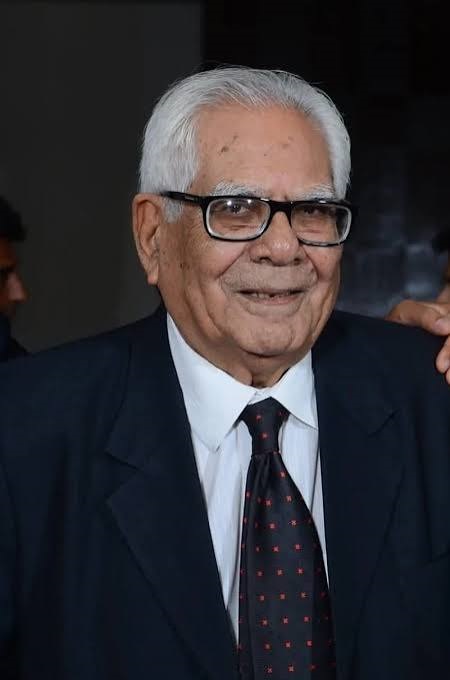
Prof. Ram Prakash Bambah (17 September 1925 – 26 May 2025) was one of India’s most celebrated and influential mathematicians, renowned globally for his profound contributions to number theory and discrete geometry. Over a career spanning more than seven decades, Prof. Bambah balanced cutting-edge mathematical research with visionary academic administration, serving as a mentor to generations of thinkers and steering Panjab University as its Vice-Chancellor.
2. Quick Facts
- Full Name: Ram Prakash Bambah
- Native Name: राम प्रकाश बाम्भा (Hindi)
- Date of Birth: September 17, 1925
- Place of Birth: Jammu, British India (with family roots extending across Punjab and Jammu)
- Nationality: Indian
- Occupation/Profession: Mathematician, Researcher, Professor, and University Administrator
- Field of Achievement: Number Theory, Discrete Geometry, and Higher Education Leadership
- Years Active: 1945 – 2025
3. Award Information (Focus: Padma Bhushan)
- Award Name: Padma Bhushan
- Award Category: India’s Third-Highest Civilian Award
- Award Year: 1988
- Presented By: The President of India
- Date of Ceremony: Republic Day Investiture, Rashtrapati Bhavan, New Delhi
- Citation/Official Reason: For exceptional and distinguished service to the nation in the field of science, education, and mathematical research.
- Previous/Next Recipients: Conferred alongside other prominent scholars, scientists, and national leaders in the 1988 honors batch.
4. Why Did He Receive the Award?
Prof. Bambah was awarded the Padma Bhushan in recognition of his towering contributions to mathematical sciences in India. His pioneering research put Indian mathematics on the global map, and his commitment to institution-building—particularly as Vice-Chancellor of Panjab University and leader of major scientific academies—strengthened the country’s academic foundation.
5. Early Life
Born in Jammu in September 1925, Bambah grew up across various towns in pre-independence northern India due to his father’s government postings. Displaying exceptional mathematical intuition and academic brightness from early childhood, he skipped grades and excelled in competitive regional scholarships, navigating the challenges of the partition era with a steadfast focus on academics.
6. Education
- Undergrad & Postgrad: Earned his Bachelor’s degree from Government College Lahore and his Master’s degree in Mathematics from the University of the Punjab, Lahore (1945).
- Doctorate (Ph.D.): Went to England as an elite scholar, earning his Ph.D. in 1950 from St. John’s College, Cambridge under the legendary supervision of Louis J. Mordell.
- Higher Doctorate: Later earned his Doctor of Science (Sc.D.) from Cambridge in 1970.
7. Career Journey
- Early Faculty Roles: Returned to independent India, serving as a Reader at Panjab University (1952) and later becoming a full Professor in 1957.
- Global Exposure: Served as a member of the prestigious Institute for Advanced Study in Princeton and held a visiting professorship at The Ohio State University (1964–1969).
- Vice-Chancellor of Panjab University (1985–1991): Steered his alma mater through critical sociopolitical periods with administrative balance and academic rigor.
- Leadership in Science: Served as President of the Indian Mathematical Society (1969), Vice-President of the Indian National Science Academy (INSA), and General President of the Indian Science Congress Association.
8. Major Achievements
- Mathematical Breakdowns: Authored dozens of high-impact research papers focusing on the geometry of numbers, covering lattice points, packing, and covering problems.
- Fellowships of Elite Academies: Elected a Fellow of the Indian National Science Academy (INSA, 1955), the Indian Academy of Sciences (IASc, 1974), and The World Academy of Sciences (TWAS).
- Prestigious Medals: Recipient of the Srinivasa Ramanujan Medal (1979) and the Aryabhata Medal (1988).
9. Contribution to the Nation
Prof. Bambah played a pivotal role in shaping modern post-independence Indian mathematical research. By bridging international standards of rigorous inquiry (from Cambridge and Princeton) with local university education in Chandigarh, he created an ecosystem where Indian students could tackle complex global mathematical challenges without needing to leave the country.
10. Other Awards and Honours
- Padma Bhushan (1988)
- Srinivasa Ramanujan Medal (INSA, 1979)
- Aryabhata Medal (INSA, 1988)
- Jawaharlal Nehru Birth Centenary Lecture Award (ISCA)
- Meghnad Saha Award (UGC)
11. Legacy and Influence
Prof. Bambah is remembered as a gentle giant—a scholar of immense humility who combined razor-sharp analytical genius with profound warmth as a teacher. His mathematical lineage and academic values continue to ripple through generations of researchers, including his own family of scientists.
12. Interesting Facts
- Academic Lineage: He was married to Saudamini (daughter of renowned Indian botanist Prana Krushna Parija), and their daughter, Bindu Bambah, followed a path of rigorous science, becoming a well-known theoretical physicist.
- A Century of Wisdom: Prof. Bambah lived a remarkable life spanning nearly an entire century, passing away in May 2025 at the age of 99, leaving behind a legacy deeply tied to the evolution of Indian academia.
- The Cambridge Connection: Under Louis J. Mordell at St. John’s College, Cambridge, he interacted with some of the greatest mathematical minds of the 20th century.
13. Quotes
“Mathematics is not just about solving equations; it is a way of thinking, seeking structural harmony, and training the human mind to look for absolute truths under complex layers.”
14. Timeline
- 1925: Born on September 17 in Jammu.
- 1945: Completes his Master’s degree from the University of the Punjab, Lahore.
- 1950: Earns his Ph.D. from St. John’s College, Cambridge under L. J. Mordell.
- 1957: Appointed Professor of Mathematics at Panjab University.
- 1979: Awarded the prestigious Srinivasa Ramanujan Medal.
- 1985–1991: Serves as the Vice-Chancellor of Panjab University.
- 1988: Conferred the Padma Bhushan and the Aryabhata Medal.
- 2025: Passes away on May 26 at the age of 99.
15. References
- Wikipedia contributors. Ram Prakash Bambah. Wikipedia, The Free Encyclopedia.
- Indian National Science Academy (INSA) & Indian Academy of Sciences (IASc) Fellow Archives.
- Bhavana Magazine. “From the Land of Five Rivers: An Interview with R. P. Bambah”.
16. Related Personalities
- Louis J. Mordell: Legendary British mathematician who supervised Prof. Bambah’s doctoral research at Cambridge.
- Srinivasa Ramanujan: India’s legendary mathematical icon, whose legacy Prof. Bambah helped champion through his research and medal lectureships.
- Prana Krushna Parija: Noted Indian botanist and Prof. Bambah’s father-in-law.
17. Frequently Asked Questions (FAQ)
Q: What was Prof. Ram Prakash Bambah famous for?
A: He was a pre-eminent Indian mathematician recognized internationally for his foundational research in number theory and discrete geometry.
Q: Did Prof. Bambah hold any administrative positions in education?
A: Yes, he served as the Vice-Chancellor of Panjab University from 1985 to 1991 and led several major scientific bodies, including the Indian Mathematical Society.
Q: What major civilian honors did he receive?
A: He was honored with the Padma Bhushan in 1988 by the Government of India.
About the Author