
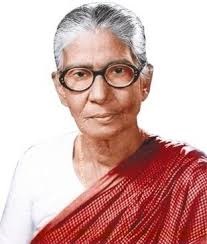
K. P. Janaki Ammal
Early Life and Education
K. P. Janaki Ammal was born on 9 December 1917 in Madurai, Tamil Nadu, to Padmanabhan and Lakshmi. Her childhood was marked by poverty and personal loss, as she lost her mother at a young age and was raised by her grandmother. Despite financial struggles, Janaki Ammal developed a strong interest in music and public performance from an early age.
She discontinued formal education after the eighth grade and joined music classes. Her talent eventually led her to the famous Palaniappa Pillai Boys Company, where she worked as a singer and later became a leading stage actress.
Education & Skills
Although Janaki Ammal did not receive higher formal education, she possessed remarkable skills in:
- Music and stage performance
- Public speaking
- Political leadership
- Social activism
- Organizing workers and women’s movements
Her powerful voice and dramatic performances became tools for spreading nationalist ideas among the public during British rule. She was known for singing patriotic songs that inspired ordinary people to participate in the freedom movement.
Contribution to Tamil Literature
K. P. Janaki Ammal’s contribution to Tamil culture came mainly through theatre and patriotic performances rather than written literature. She used Tamil drama and songs to spread awareness about:
- Freedom from British rule
- Social equality
- Anti-untouchability campaigns
- Women’s participation in public life
Her stage performances carried strong nationalist messages and helped bring political awareness to common people in Tamil-speaking regions. Through theatre, she made political ideas accessible to the masses.
Role in India’s Freedom Movement
Janaki Ammal became actively involved in India’s freedom struggle at a very young age. During her theatre performances, she sang revolutionary songs against British rule, which attracted the attention of colonial authorities.
She was arrested for the first time in 1930 while performing in Tirunelveli and spent a year in prison. She is remembered as one of the first South Indian women to be arrested by the British government for nationalist activities.
Political Activities
- Joined the Indian National Congress in 1936
- Worked in the Madurai Congress Committee
- Participated in the Individual Satyagraha Movement
- Later joined the Communist Party of India in 1940
- Continued activism through the Communist Party of India (Marxist) after the party split
She also fought for:
- Workers’ rights
- Fair wages for laborers and mill workers
- Women’s rights and social justice
In 1967, she was elected to the Tamil Nadu Legislative Assembly from Madurai East.
Personal Life
Janaki Ammal married Gurusamy Naidu, a harmonium player in her theatre troupe. Their shared involvement in music and political awareness strengthened her dedication to social causes.
She lived a simple and selfless life. During the Emergency period, she reportedly sold her jewelry and silk clothes to support party workers and social causes.
Why Important in Indian History
K. P. Janaki Ammal occupies an important place in Indian history because she represented the fearless participation of women in India’s struggle for independence.
Her Importance Includes:
- One of the earliest women freedom fighters from South India
- Among the first South Indian women arrested by the British
- Used art and theatre as tools of political resistance
- Worked for both national freedom and social equality
- Inspired women to enter politics and activism
She demonstrated that women could lead public movements and challenge colonial power at a time when society placed heavy restrictions on women.
One of the Early Revolutionaries
Janaki Ammal belongs to the generation of early revolutionaries who combined nationalism with social reform. Unlike many leaders who focused only on political freedom, she also fought against caste discrimination, poverty, and exploitation of workers.
Her activism connected:
- Freedom struggle
- Women’s empowerment
- Labor rights
- Social justice movements
This made her a unique and influential figure in Tamil Nadu’s political history.
Legacy and Recognition
K. P. Janaki Ammal is remembered as:
- A courageous freedom fighter
- A women’s rights activist
- A political leader from Tamil Nadu
- A pioneer in grassroots social activism
She was one of the founders of the Tamil Nadu Democratic Women’s Association and served as its first president.
Even though she made immense sacrifices for the country, she reportedly declined special privileges such as the freedom fighter’s pension and honors, reflecting her simplicity and dedication to public service.
Today, historians and social activists recognize her as an “unsung heroine” of India’s freedom movement.
Death
Years of imprisonment, political struggles, and continuous public work affected her health. K. P. Janaki Ammal passed away on 1 March 1992 due to asthma-related complications.
Conclusion
K. P. Janaki Ammal was far more than a political activist — she was a symbol of courage, sacrifice, and social commitment. From the theatre stage to prison cells and finally to the legislative assembly, her life reflected complete dedication to the people of India.
Her journey reminds us that the freedom movement was shaped not only by famous national leaders but also by fearless regional heroes who inspired ordinary citizens through art, activism, and personal sacrifice. K. P. Janaki Ammal remains an enduring inspiration for women, activists, and all those who believe in justice and equality.
About the Author