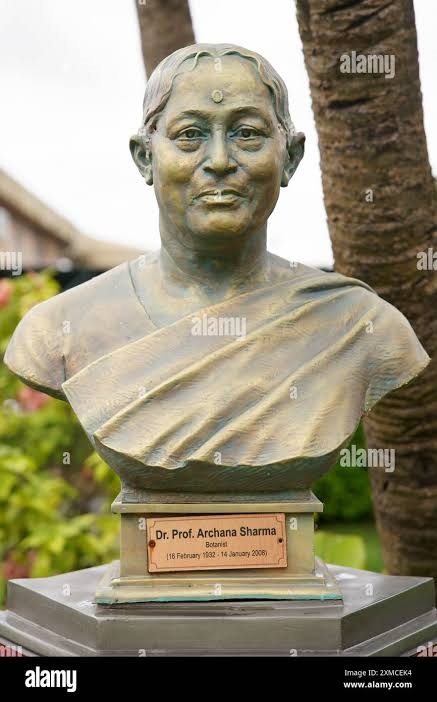
Here is a comprehensive, structured guide tailored for your blog on Dr. Archana Sharma, organized precisely according to your requested outline.
1. Introduction
Dr. Archana Sharma (1932–2008) was a trailblazing Indian botanist, cytogeneticist, and cell biologist. Widely recognized for her monumental research into plant and human genetics, she expanded our understanding of how asexually reproducing plants evolve, pioneered techniques in chromosome study, and researched the health impacts of environmental pollutants like arsenic.
2. Quick Facts
- Full Name: Archana Sharma
- Native Name: অৰ্চনা শৰ্মা / अर्चना शर्मा (Bengali/Hindi context)
- Date of Birth: 16 February 1932
- Place of Birth: Pune, Maharashtra, India
- Nationality: Indian
- Occupation/Profession: Botanist, Cytogeneticist, Cell Biologist, and University Professor
- Field of Achievement: Cytogenetics, Botany, and Environmental Mutagenesis
- Years Active: 1950s–2007
3. Award Information (Padma Bhushan)
- Award Name: Padma Bhushan
- Award Category: India’s Third-Highest Civilian Honour
- Award Year: 1984
- Presented By: The President of India
- Date of Ceremony: 1984 (Republic Day honors cycle)
- Citation/Official Reason: Awarded in recognition of her distinguished service, pioneering scientific output, and immense contributions to science, education, and botanical research.
- Previous Recipients: Eminent scientists, artists, and public figures from preceding honor cycles.
- Next Recipients: Notable national achievers from subsequent honor lists.
4. Why They Received the Award
Dr. Archana Sharma received the Padma Bhushan for her lifelong, path-breaking research in cytogenetics, her development of global-standard laboratory techniques for studying chromosomes, and her tireless service to Indian scientific administration and education.
5. Early Life
Born in Pune on February 16, 1932, Archana Sharma grew up in a rich academic environment surrounded by educators (her father and grandfather were both university professors). She spent her early years and completed her initial schooling in Rajasthan before moving forward with higher scientific pursuits.
6. Education
- Schooling & Undergraduate: Completed her early education in Rajasthan and earned her B.Sc. degree from Bikaner.
- Postgraduate Degree: Earned her Master’s degree (M.Sc.) in Botany from the University of Calcutta in 1951.
- Doctorate & D.Sc.: Secured her Ph.D. in 1955 and her D.Sc. in 1960 from the University of Calcutta, becoming only the second woman to receive a D.Sc. from the institution.
7. Career Journey
- Faculty Positions: Joined the University of Calcutta faculty in 1967, rising to become Professor of Genetics in 1972 at the Centre of Advanced Studies in Cell and Chromosome Research.
- Administrative Leadership: Served as Head of the Department of Botany at the University of Calcutta from 1981 to 1983.
- National Roles: Actively served on premier policy-making boards including the University Grants Commission (UGC), the Science and Engineering Research Council (DST), and the Environment Research Council (MoEF).
8. Major Achievements
- Chromosome Techniques: Alongside her husband and collaborator, Professor Arun Kumar Sharma, she developed innovative pre-treatment and staining techniques for studying chromosome structures, which became standard worldwide.
- Speciation Concept: Published a breakthrough concept regarding the evolution and speciation of vegetatively (asexually) reproducing plants in the prestigious journal Nature.
- Toxicology and Health: Led critical studies examining how long-term exposure to heavy metals like arsenic in water induces mutations and health risks, while researching plant-based products to counter such toxicity.
9. Contribution to the Nation
Dr. Sharma shaped Indian science policy at structural levels. She mentored over 70 Ph.D. students, built an elite research school in cytogenetics, and helped steer national agendas in biotechnology, environmental protection, and scientific education.
10. Other Awards and Honours
- J.C. Bose Award (1972)
- Shanti Swarup Bhatnagar Prize (1975) – India’s highest science award in the biological sciences category.
- FICCI Award (1983)
- Birbal Sahni Medal (1984)
- Padma Bhushan (1984)
- General President, Indian Science Congress Association (1986–1987).
11. Legacy and Influence
Remembered affectionately as “Didi” by her students and peers, Dr. Archana Sharma left an indelible imprint on global genetics and botany. Her co-authored text, Chromosome Techniques: Theory and Practice, remains a foundational global benchmark. She was also the founder and long-standing editor of the international journal The Nucleus.
12. Interesting Facts
- Power Couple of Science: She was married to Professor Arun Kumar Sharma, widely regarded as the “Father of Indian Cytology”, with whom she shared a legendary scientific partnership.
- Prolific Author: Throughout her life, she published around 10 books and authored between 300 and 400 high-impact research papers.
- Spiritual Dedication: Despite her extremely hectic academic and administrative schedules, she dedicated a significant portion of her personal time to social service through the Ramakrishna Mission and Sri Sarada Math.
13. Quotes
“Scientific inquiry must always bridge laboratory discoveries with the practical welfare of the environment and human society.” — (Reflecting her holistic approach to biological and environmental research)
14. Timeline
- 1932: Born on February 16 in Pune, Maharashtra
- 1951: Completed her M.Sc. in Botany from the University of Calcutta
- 1955: Earned her Ph.D. degree
- 1960: Awarded her D.Sc. degree
- 1975: Awarded the Shanti Swarup Bhatnagar Prize
- 1984: Conferred the Padma Bhushan by the Government of India
- 1986–1987: Served as General President of the Indian Science Congress Association
- 2008: Passed away on January 14 at the age of 75
15. References
- Wikipedia contributors. “Archana Sharma (botanist).” Wikipedia, The Free Encyclopedia.
- Asia Research News / Feminism in India Archives. “Dr. Archana Sharma: The Pioneering Indian Botanist”.
- Archana Sharma Foundation & Indian National Science Academy (INSA) Biographical Memoirs.
16. Related Personalities
- Arun Kumar Sharma (Renowned cytologist, her husband and close research partner)
- Birbal Sahni (Legendary Indian paleobotanist)
- J.C. Bose (Pioneering Indian polymath and plant physiologist)
17. Frequently Asked Questions (FAQ)
- Q: Who was Dr. Archana Sharma?A: She was a prominent Indian botanist, cytogeneticist, and cell biologist renowned for her work on plant chromosomes and environmental mutagenesis.
- Q: What are her major contributions to science?A: She developed breakthrough chromosome-staining techniques, researched speciation in asexually reproducing plants, and studied the toxicological impacts of heavy metals like arsenic in water.
- Q: When did she receive the Padma Bhushan?A: She was honored with the Padma Bhushan in 1984.
About the Author