

1. Introduction
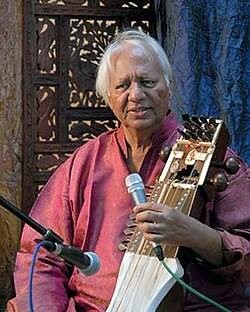
Pandit Ram Narayan was a legendary Indian musician who single-handedly transformed the status of the sarangi, elevating it from a secondary accompanying instrument to a revered solo concert instrument in Hindustani classical music. Popularly known as Panditji, he was the first sarangi player to achieve international acclaim, paving the way for future generations and leaving an indelible mark on Indian classical heritage.
2. Quick facts
- Full Name: Ram Narayan
- Native Name: राम नारायण
- Date of birth: 25 December 1927
- Place Of birth: Amber village, near Udaipur, Rajasthan, India
- Nationality: Indian
- Occupation/ Profession: Musician, Classical Instrumentalist, Teacher
- Field of Achievement: Hindustani Classical Music (Sarangi)
- Years Active: 1944–2013
3. Award Information
- Award Name: Padma Vibhushan
- Award Category: India’s Second-Highest Civilian Award
- Award Year: 2005
- Presented By: President of India
- Date of Ceremony: March 2005
- Citation/Official Reason: For exceptional and distinguished service in the field of art and classical music.
- Previous Recipients (optional): Prominent artists and scientists from diverse fields.
- Next Recipients: Subsequent figures in arts and public service.
4. Why they Receive the award?
Pandit Ram Narayan received the Padma Vibhushan and other top national honours for his lifetime devotion to pioneering the sarangi as a solo performance instrument. Historically, the instrument was associated primarily with vocal accompaniment and carried a social stigma. Through his virtuosic mastery, relentless dedication, and global concert tours, he brought unprecedented dignity, recognition, and global respect to the sarangi.
5. Early Life
Born in a village near Udaipur, Rajasthan, Ram Narayan came from a family with a rich musical background. His great-great-grandfather and great-grandfather were singers for the ruler of Udaipur, and his father played the dilruba. Fascinated by sound from childhood, he began teaching himself to play the sarangi by observing local practitioners like Uday Lal and later studied under singers and masters, mastering the nuances of the khyal vocal style on his instrument.
6. Education
His education was deeply rooted in the traditional guru-shishya parampara. Instead of conventional schooling, young Ram Narayan immersed himself completely in rigorous musical training under various ustads and vocalists. Learning vocal styles helped him adapt the human voice’s emotional range directly onto the strings of the sarangi.
7. Carrier Journey
- 1944: Joined All India Radio in Lahore as a staff accompanist for vocalists.
- 1947: Moved to Delhi following the partition of India.
- 1949: Relocated to Mumbai to work in the Hindi film industry, contributing to iconic compositions like Pakeezah.
- 1956: Abandoned accompanying work entirely to debut as a full-time solo concert artist.
- 1964: Embarked on his first major international tour to America and Europe alongside his brother Chatur Lal.
8. Major Achievements
- First sarangi player to establish a global career and perform widely across Western countries.
- Successfully redefined the sarangi as a complete solo concert vehicle capable of executing complex alap, jod, jhala, and gat sequences.
- Recorded numerous landmark solo albums and collaborated with international musicians.
- Established an educational lineage, teaching students from across India and the world.
9. Contribution to the nation
Pandit Ram Narayan elevated India’s rich classical heritage on global platforms, putting an indigenous bowed instrument on the international map. By erasing the social stigmas previously attached to the sarangi, he rescued a vital part of India’s folk and classical roots, institutionalizing its training through foundations and inspiring modern instrumentalists.
10. Other Awards and Honours
- Padma Shri: 1976
- Sangeet Natak Akademi Award: 1975
- Padma Bhushan: 1991
- Rajasthan Ratna: 2013
- Sur Jyotsna National Music Award Legend: 2024
11. Legacy and influence
Panditji is remembered as the father of modern solo sarangi playing. His stylistic innovations, fingering techniques, and uncompromising dedication inspired family members—including his daughter Aruna Narayan, son Brij Narayan, and grandson Harsh Narayan—to carry forward the tradition. His legacy remains a cornerstone of Hindustani instrumental music.
12. Interesting Facts
- He initially considered abandoning the sarangi and switching to singing after an early solo performance in Mumbai was cut short, but persevered due to his deep passion for the instrument.
- He famously remarked, “Music is my religion,” believing it was the purest doorway to divinity.
- His brother, Chatur Lal, was a legendary tabla maestro who pioneered international tabla awareness alongside him.
13. Quotes
“My mission was to obliterate the blemish which the sarangi carried due to its social origins. I hope I have succeeded in this.” — Pandit Ram Narayan
14. Timeline
- 1927: Born on 25 December in Udaipur, Rajasthan
- 1944: Joined All India Radio, Lahore
- 1956: Debuted as an independent solo concert artist
- 1975: Awarded the Sangeet Natak Akademi Award
- 2005: Conferred with the Padma Vibhushan
- 2024: Passed away on 9 November at the age of 96
15. References
- Wikipedia: Ram Narayan
- Sarangi.net biographical archives
- Writings: Indian music in performance: a practical introduction (1980) and Ek Sur Mera Ek Sarangi Ka (2009)
16. Related Personalities
- Chatur Lal (Tabla exponent and brother)
- Pandit Ravi Shankar (Sitar maestro and contemporary)
- Brij Narayan (Sarod player and son)
- Ustad Sultan Khan (Fellow legendary sarangi maestro)
17. Frequently Asked Questions (FAQ)
- Q: What instrument did Pandit Ram Narayan play?A: He played the sarangi, a traditional Indian bowed string instrument.
- Q: Why is he considered a pioneer?A: He was the first musician to successfully present the sarangi as a solo lead instrument on global concert stages, breaking its traditional role as a mere vocal accompaniment.
- Q: Which major civilian awards did he receive?A: He received the Padma Shri (1976), Padma Bhushan (1991), and India’s second-highest civilian honour, the Padma Vibhushan (2005).
About the Author




