Introduction
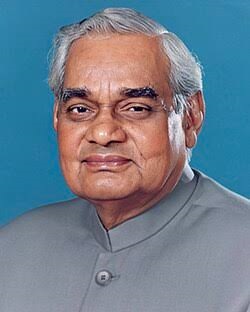
Atal Bihari Vajpayee was one of India’s most respected politicians, orators, poets, and statesmen. He served as the 10th Prime Minister of India and played a major role in shaping India’s political, economic, and foreign policies. Known for his powerful speeches, democratic values, and diplomatic approach, Vajpayee was admired across political parties. He was honoured with the Padma Vibhushan for his exceptional contribution to public affairs and national service.
Early Life
Atal Bihari Vajpayee was born on 25 December 1924 in Gwalior, Madhya Pradesh, India. His father, Krishna Bihari Vajpayee, was a school teacher and a poet who influenced Atal’s interest in literature and writing.
From a young age, Vajpayee showed a strong interest in public speaking, social issues, and national development. His skills as a speaker and thinker helped him become one of India’s most influential leaders.
He passed away on 16 August 2018 in New Delhi, India, at the age of 93.
Education and Career
Atal Bihari Vajpayee completed his education at Victoria College (now Maharani Laxmi Bai Government College) in Gwalior and later studied at DAV College, Kanpur, where he earned a master’s degree in Political Science.
He began his career as a journalist and worked with newspapers before entering politics. He became associated with the Bharatiya Jana Sangh and later became a founding member of the Bharatiya Janata Party (BJP).
His political career spanned more than five decades, during which he held several important positions, including Member of Parliament and Prime Minister of India.
Career and Achievements
Atal Bihari Vajpayee became the Prime Minister of India three times:
- First term: 1996 (for a short period)
- Second term: 1998–1999
- Third term: 1999–2004
Major achievements during his leadership include:
1. Pokhran-II Nuclear Tests (1998)
Under his leadership, India conducted nuclear tests at Pokhran, establishing India as a nuclear-capable nation.
2. Kargil War Leadership (1999)
Vajpayee provided strong leadership during the Kargil War and supported the Indian Armed Forces.
3. Infrastructure Development
His government launched major infrastructure projects, including the Golden Quadrilateral highway project, which improved road connectivity across India.
4. Economic Reforms
He supported economic reforms, privatization, and policies aimed at encouraging investment and growth.
5. Peace Initiatives
Vajpayee worked to improve relations with neighbouring countries, especially through the historic Delhi–Lahore bus journey in 1999.
Why Did Atal Bihari Vajpayee Receive the Padma Vibhushan Award?
Atal Bihari Vajpayee received the Padma Vibhushan in 1992 for his outstanding contribution to public affairs.
The award recognized:
- His decades of service in Indian politics.
- His role as a respected parliamentarian.
- His contribution to democratic values and national development.
- His leadership in shaping India’s domestic and foreign policies.
His ability to communicate effectively and build consensus made him a respected figure in Indian public life.
Field of Achievements
Atal Bihari Vajpayee contributed significantly in various fields:
1. Politics and Governance
He played a key role in Indian democracy and served as Prime Minister during important periods of national development.
2. Foreign Relations
He worked to strengthen India’s relations with other countries through diplomacy and peace efforts.
3. Infrastructure Development
His government focused on improving transportation networks and connectivity.
4. Literature and Poetry
Apart from politics, Vajpayee was a talented Hindi poet and writer. His poems reflected patriotism, humanity, and social values.
Awards and Honours
Some major awards and honours received by Atal Bihari Vajpayee include:
- Padma Vibhushan (1992) – India’s second-highest civilian award.
- Bharat Ratna (2015) – India’s highest civilian award.
- Best Parliamentarian Award (1994) – For his outstanding contribution as a parliamentarian.
- Several national and international recognitions for leadership and public service.
Interesting Facts About Atal Bihari Vajpayee
- Atal Bihari Vajpayee was the first non-Indian National Congress Prime Minister to complete a full five-year term.
- He was known as an excellent orator and could connect with people through his speeches.
- He was also a respected Hindi poet.
- His birthday, 25 December, is celebrated in India as Good Governance Day.
- He served as a Member of Parliament for over four decades.
Legacy and Inspiration
Atal Bihari Vajpayee’s legacy continues through his values of democracy, dialogue, and national development. He is remembered as a leader who combined strong decision-making with a peaceful approach.
His life inspires young people to develop leadership qualities, respect democratic principles, and work for the progress of the nation.
Contribution to the Nation
Atal Bihari Vajpayee made several important contributions to India:
- Strengthened India’s position in global affairs.
- Improved national infrastructure through major development projects.
- Guided India during important security challenges.
- Promoted peace and dialogue with neighbouring countries.
- Encouraged economic growth and modernization.
- Set an example of respectful and responsible political leadership.
Conclusion
Atal Bihari Vajpayee was a visionary leader whose contributions shaped modern India. His achievements in politics, diplomacy, infrastructure, and literature earned him admiration across the country. The Padma Vibhushan and Bharat Ratna awards reflect his extraordinary service to the nation. His life remains a source of inspiration for generations to come.
About the Author