
Srinivasa Ramanujan – Number Theory & Infinite Series
Introduction
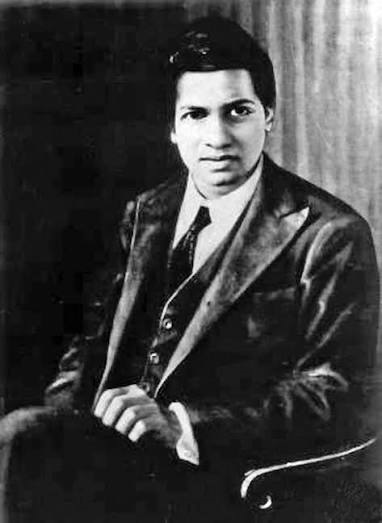
Srinivasa Ramanujan was one of the greatest mathematical geniuses in history. Despite having little formal training in advanced mathematics, he made extraordinary contributions to number theory, infinite series, continued fractions, and mathematical analysis. His remarkable intuition and originality led to discoveries that continue to influence modern mathematics, computer science, and physics. Ramanujan’s work earned worldwide recognition and established him as one of India’s most celebrated mathematicians.
Early Life and Education
Srinivasa Ramanujan was born on December 22, 1887, in Erode, Tamil Nadu, India. He grew up in Kumbakonam, where he displayed exceptional mathematical talent from a young age.
At the age of 16, he obtained a copy of G. S. Carr’s book A Synopsis of Elementary Results in Pure Mathematics. This book inspired him to independently explore advanced mathematical concepts. Although he excelled in mathematics, his focus on the subject caused him to neglect other studies, preventing him from completing a conventional university degree.
Despite financial hardships, he continued his mathematical research and filled notebooks with thousands of original formulas and theorems.
Scientific Career & Research
Ramanujan’s life changed when he wrote to G. H. Hardy at the University of Cambridge in 1913. Hardy immediately recognized his extraordinary talent and invited him to England.
At Cambridge, Ramanujan collaborated with Hardy and other leading mathematicians. His research focused on:
- Number Theory
- Infinite Series
- Continued Fractions
- Partition Functions
- Modular Forms
- Mathematical Analysis
During a short but highly productive career, he produced groundbreaking results that transformed several branches of mathematics.
Major Discoveries and Inventions
Partition Theory
Ramanujan developed important formulas related to partition functions, which count the number of ways an integer can be expressed as a sum of positive integers.
Infinite Series
He discovered remarkable infinite series expansions, including rapidly converging formulas for calculating π (pi), which are still used in modern computational mathematics.
Ramanujan Prime and Number Theory
His work introduced new concepts and theorems in number theory that remain active areas of research today.
Continued Fractions
Ramanujan made pioneering contributions to the theory of continued fractions, uncovering elegant mathematical identities.
Mock Theta Functions
One of his final and most mysterious discoveries was the theory of mock theta functions, which later became important in modern mathematics and theoretical physics.
Ramanujan-Hardy Number
The famous number 1729, known as the Hardy-Ramanujan number, became legendary because it is the smallest number expressible as the sum of two cubes in two different ways.
Awards and Honours
Although Ramanujan’s career was brief, he received several prestigious honours:
- Elected Fellow of the Royal Society in 1918.
- Became the first Indian Fellow of Trinity College Cambridge.
- Widely recognized as one of the greatest mathematicians of the twentieth century.
- India’s National Mathematics Day is celebrated on December 22, his birthday.
Later Life and Death
Ramanujan’s health deteriorated during his stay in England. He returned to India in 1919 but remained seriously ill.
He passed away on April 26, 1920, in Kumbakonam, Tamil Nadu, at the age of just 32. Despite his short life, he produced an extraordinary body of mathematical work that continues to be studied and expanded upon.
Legacy and Impact
Ramanujan’s influence on mathematics is immense. His notebooks contained thousands of formulas, many of which were decades ahead of their time. Researchers continue to verify, interpret, and apply his discoveries.
His legacy includes:
- Transforming number theory and mathematical analysis.
- Inspiring generations of mathematicians worldwide.
- Contributing to modern cryptography and computer science.
- Influencing theoretical physics through mock theta functions.
- Demonstrating the power of intuition and creativity in mathematics.
His life story remains an inspiration to students, scientists, and mathematicians across the world.
Conclusion
Srinivasa Ramanujan was a mathematical genius whose discoveries revolutionized number theory, infinite series, and many other branches of mathematics. Despite facing poverty, limited formal education, and health challenges, he achieved extraordinary success through dedication and exceptional talent. His contributions continue to shape modern mathematical research, making him one of the most influential mathematicians in history.
Short Blog Summary (200 Words)
Srinivasa Ramanujan (1887–1920) was an extraordinary Indian mathematician whose groundbreaking work transformed number theory and mathematical analysis. Born in Erode and raised in Kumbakonam, Tamil Nadu, he displayed remarkable mathematical talent from a young age. Largely self-taught, he developed advanced mathematical ideas independently, filling notebooks with innovative formulas and theorems.
In 1913, Ramanujan wrote to British mathematician G. H. Hardy at Cambridge University. Impressed by his brilliance, Hardy invited him to England, where the two collaborated on several important mathematical problems. Ramanujan made significant contributions to partition theory, infinite series, continued fractions, and modular forms. He also discovered mock theta functions, which later became important in modern mathematics and theoretical physics.
One of his most famous achievements was developing rapidly converging series for calculating π, which remain useful in computational mathematics. He was elected a Fellow of the Royal Society in 1918 and became the first Indian Fellow of Trinity College, Cambridge.
Although he died at the age of 32, Ramanujan left behind thousands of mathematical results that continue to inspire research today. His life is a testament to the power of genius, perseverance, and creativity, making him one of the greatest mathematicians the world has ever known.
About the Author