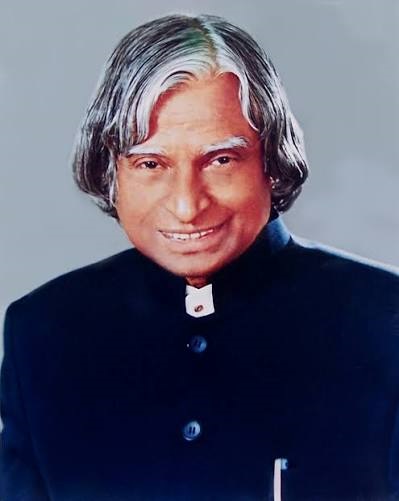
1. Introduction
Avul Pakir Jainulabdeen Abdul Kalam (1931–2015), universally known as Dr. A. P. J. Abdul Kalam, was an extraordinary Indian aerospace scientist, statesman, and the 11th President of India. Widely revered as the “Missile Man of India” for his pivotal role in the development of the nation’s ballistic missile and launch vehicle technology, he spent decades mentoring youth and championing a vision to transform India into a developed nation by 2020. Popularly called the “People’s President,” his humility, warmth, and profound dedication to education left an indelible mark on the global conscience.
2. Quick Facts
- Full Name: Avul Pakir Jainulabdeen Abdul Kalam
- Native Name: அவுல் பக்கீர் ஜைனுலாப்தீன் அப்துல் கலாம்
- Date of Birth: October 15, 1931
- Place of Birth: Rameswaram, Ramanathapuram District, Madras Presidency, British India (now Tamil Nadu, India)
- Nationality: Indian
- Occupation/Profession: Aerospace Scientist, Author, Professor, and Statesman
- Field of Achievement: Aerospace Engineering, Defense Technology, and Public Administration
- Years Active: 1958 – 2015
3. Award Information (Focus: Padma Bhushan)
- Award Name: Padma Bhushan
- Award Category: Civil Honour (Third-highest civilian award in India)
- Award Year: 1981
- Presented By: Government of India (Presented by President Neelam Sanjiva Reddy)
- Date of Ceremony: 1981 (Annual Investiture Ceremony, Rashtrapati Bhavan, New Delhi)
- Citation/Official Reason: For exceptional and distinguished services to science, engineering, and the technological advancement of India’s defense infrastructure.
- Previous Recipients: Notable scientists, academicians, and leaders from preceding years.
- Next Recipients: Notable figures in science, public affairs, and literature from subsequent years.
4. Why They Receive the Award
Dr. Kalam received the Padma Bhushan in 1981 for his breakthrough leadership as a project director at ISRO—where he successfully spearheaded India’s first indigenous satellite launch vehicle project (SLV-III)—and his subsequent efforts to build India’s strategic defense systems through the Integrated Guided Missile Development Program (IGMDP).
5. Early Life
Born into a modest Tamil Muslim family in the pilgrimage island town of Rameswaram, Dr. Kalam grew up facing financial hardships. His father, Jainulabdeen, owned a boat and rented it to Hindu pilgrims, while his mother, Ashiamma, was a housewife. As a young boy, Kalam distributed newspapers across Rameswaram to supplement his family’s income. Despite these struggles, he was an inquisitive child with a deep passion for mathematics and physics, drawing immense inspiration from his school teachers and the multi-religious harmony of his hometown.
6. Education
- Schooling: Schwartz Higher Secondary School, Ramanathapuram.
- Undergraduate: Graduated with a Bachelor of Science (B.Sc.) degree in Physics from St. Joseph’s College, Tiruchirappalli (1954).
- Engineering Specialization: Studied Aerospace Engineering at the Madras Institute of Technology (MIT), graduating in 1960.
7. Career Journey
- DRDO & ISRO Pioneer: Began his career as a scientist at the Aeronautical Development Establishment of the Defence Research and Development Organisation (DRDO), later moving to ISRO in 1969 as the Project Director of India’s first indigenous Satellite Launch Vehicle (SLV-III), which successfully orbited the Rohini satellite in 1980.
- Strategic Defense Architect: Returned to DRDO in 1982, directing the Integrated Guided Missile Development Program (IGMDP), which birthed iconic missiles like Agni and Prithvi.
- Chief Scientific Advisor: Served as the Principal Scientific Advisor to the Government of India and Chief Scientific Advisor to the Prime Minister (1992–1999), playing a key organizational role in the 1998 Pokhran-II nuclear tests.
- Presidency (2002–2007): Served as the 11th President of India, endearing himself to millions as an accessible, inspiring people’s leader.
8. Major Achievements
- Bharat Ratna (1997): Awarded India’s highest civilian honor for his stellar contributions to scientific research and national defense.
- SLV-III Triumph: Successfully engineered India’s entry into the elite club of space-faring nations with the successful flight of the SLV-III.
- Prolific Author: Wrote several globally acclaimed books, including Wings of Fire, Ignited Minds, India 2020, and Transcendence.
9. Contribution to the Nation
Dr. Kalam secured India’s technological and sovereign independence by laying the bedrock of its indigenous space and missile programs. Beyond defense, his tenure as President redefined the office, transforming Rashtrapati Bhavan into a home for ordinary citizens, children, and scholars. In his post-presidency years, he traveled relentlessly across schools and universities, interacting with millions of students to ignite their imagination and build a corruption-free, developed India.
10. Other Awards and Honours
- Padma Shri (1981) – Conferred by the Government of India
- Padma Bhushan (1981) – Conferred by the Government of India
- Bharat Ratna (1997) – Conferred by the Government of India
- Indira Gandhi Award for National Integration (1997)
- King Charles II Medal (2007) – Royal Society, UK
- Hoover Medal (2008) – ASME Foundation, USA
- Honorary Doctorates: Received from over 40 prestigious universities worldwide.
11. Legacy and Influence
Dr. Kalam’s legacy transcends science and politics; he remains an eternal symbol of hope, simplicity, and relentless optimism. His birthday, October 15, is celebrated across India as World Students’ Day in honor of his deep love for teaching and youth empowerment.
12. Interesting Facts
- The People’s President: Even after moving into Rashtrapati Bhavan, he owned very few personal belongings—primarily books, his clothes, a veena, and a small writing desk.
- Unwavering Dedication: While working on the SLV-III project, he absorbed the failure of a 1979 launch with supreme grace, publicly shielding his team, and then led a successful launch a year later.
- Music and Poetry: Alongside engineering, he loved playing the traditional Indian string instrument, the veena, and wrote inspiring Tamil poems.
13. Quotes
“Dream, dream, dream. Dreams transform into thoughts and thoughts result in action.”
14. Timeline
- 1931: Born on October 15 in Rameswaram, Tamil Nadu
- 1954: Graduates with a B.Sc. in Physics from St. Joseph’s College
- 1960: Completes Aeronautical Engineering from MIT, Madras
- 1980: Successfully launches the Rohini satellite via SLV-III
- 1981: Conferred both the Padma Shri and the Padma Bhushan by the Government of India
- 1997: Awarded the Bharat Ratna, India’s highest civilian honor
- 1998: Oversees the Pokhran-II nuclear tests as Chief Scientific Advisor
- 2002: Elected as the 11th President of India
- 2007: Completes his presidential term and returns to teaching and writing
- 2015: Passes away on July 27 while delivering a lecture at IIM Shillong
15. References
- Wikipedia contributors. A. P. J. Abdul Kalam. Wikipedia, The Free Encyclopedia.
- Kalam, A.P.J. Abdul, with Arun Tiwari. Wings of Fire: An Autobiography (Universities Press).
- ISRO Official Archives – SLV-III Mission Profile.
- DRDO, Ministry of Defence, Government of India – Dr. A.P.J. Abdul Kalam Tribute Pages.
16. Related Personalities
- Vikram Sarabhai – Father of the Indian space program and a crucial early mentor to Kalam.
- Satish Dhawan – Eminent aerospace engineer and former Chairman of ISRO who guided Kalam through the SLV project.
- Atal Bihari Vajpayee – Former Prime Minister of India who worked closely with Kalam during the Pokhran tests and his nomination to the presidency.
17. Frequently Asked Questions (FAQ)
Q: Who was Dr. A. P. J. Abdul Kalam?
A: Dr. A. P. J. Abdul Kalam was an iconic Indian aerospace scientist, author, and the 11th President of India, famously known as the “Missile Man of India.”
Q: Why is he called the Missile Man of India?
A: He earned this title due to his instrumental leadership in developing India’s ballistic missile technology and directing the Integrated Guided Missile Development Program.
Q: Did Dr. Kalam receive the Bharat Ratna?
A: Yes, he was awarded India’s highest civilian honor, the Bharat Ratna, in 1997.
Q: When did Dr. Kalam pass away?
A: He passed away on July 27, 2015, after collapsing during a lecture at the Indian Institute of Management (IIM) Shillong.
About the Author