![cropped-ChatGPT-Image-Jun-29-2026-07_22_15-PM-300x84[1]](https://tamilwarriors.com/wp-content/uploads/2026/07/cropped-ChatGPT-Image-Jun-29-2026-07_22_15-PM-300x841-1.png)
Introduction
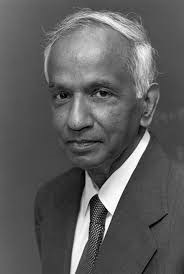
Subrahmanyan Chandrasekhar (1910–1995) was one of the greatest astrophysicists of the 20th century. He was an Indian-born scientist whose groundbreaking research helped transform our understanding of stars, black holes, and the evolution of the universe.
Popularly known as S. Chandrasekhar, he made major contributions to astrophysics and received the Nobel Prize in Physics in 1983 for his studies of the physical processes important to the structure and evolution of stars. He was also awarded the Padma Vibhushan in 1968 by the Government of India for his outstanding contribution to science.
Why Did Subrahmanyan Chandrasekhar Receive the Padma Vibhushan Award?
Subrahmanyan Chandrasekhar received the Padma Vibhushan in 1968 for his exceptional achievements in the field of science and technology, especially astrophysics.
The award recognized his:
- Revolutionary research on stellar structure and evolution.
- Discovery of the Chandrasekhar Limit, which explains the maximum mass a white dwarf star can have before collapsing.
- Contributions to theoretical physics and astronomy.
- Global recognition of India’s contribution to scientific research.
His discoveries helped scientists understand how stars are born, change over time, and eventually die.
Early Life
Subrahmanyan Chandrasekhar was born on 19 October 1910 in Lahore, British India (now in Pakistan). He belonged to a family with a strong academic background.
His uncle was the famous Indian physicist C. V. Raman, who won the Nobel Prize in Physics in 1930.
From childhood, Chandrasekhar showed exceptional talent in mathematics and science. His curiosity about the universe inspired him to study astronomy and physics.
Education and Career
Chandrasekhar completed his early education in India and studied at Presidency College, Chennai. He later went to the University of Cambridge in England for higher studies.
During his journey to Cambridge, he developed his famous theory about the structure of stars.
Academic Career:
- He joined the University of Chicago in 1937 and spent most of his scientific career there.
- He worked at the Yerkes Observatory.
- He became one of the leading researchers in theoretical astrophysics.
- He served as the editor of the scientific journal The Astrophysical Journal for many years.
Career and Achievements
Subrahmanyan Chandrasekhar made many important discoveries in physics and astronomy.
1. Discovery of the Chandrasekhar Limit
His most famous achievement was the discovery of the Chandrasekhar Limit.
- He showed that a white dwarf star cannot remain stable if its mass exceeds about 1.4 times the mass of the Sun.
- Beyond this limit, the star collapses, which can lead to events such as supernova explosions or the formation of neutron stars and black holes.
This discovery became one of the foundations of modern astrophysics.
2. Research on Stellar Evolution
Chandrasekhar studied how stars change throughout their life cycles. His work explained:
- How stars are formed.
- How they use nuclear fuel.
- How they end their lives.
3. Contributions to Physics
He contributed to many areas, including:
- Radiation theory.
- Black hole physics.
- Fluid dynamics.
- Mathematical methods in astrophysics.
Field of Achievements
Subrahmanyan Chandrasekhar’s major fields of achievement include:
Astrophysics
He explained the life cycle of stars and their internal structures.
Theoretical Physics
He applied advanced mathematics to understand complex physical processes.
Astronomy
His research improved humanity’s understanding of galaxies, stars, and the universe.
Scientific Research and Education
He trained many scientists and contributed greatly to global scientific knowledge.
Awards and Honours
Subrahmanyan Chandrasekhar received many prestigious awards, including:
- Padma Vibhushan (1968) – India’s second-highest civilian honour.
- Nobel Prize in Physics (1983) – For his theoretical studies of physical processes important to the structure and evolution of stars.
- National Medal of Science (1966) – One of the highest scientific honours in the United States.
- Royal Medal (1962) – Awarded by the Royal Society.
- Copley Medal (1984) – One of the oldest scientific awards.
Interesting Facts About Subrahmanyan Chandrasekhar
- He was only 19 years old when he developed the basic ideas behind the Chandrasekhar Limit.
- The element astatine and several astronomical concepts are studied using principles connected to his research.
- He was one of the few scientists who successfully combined mathematics and astronomy to explain the universe.
- His Nobel Prize was shared with William Alfred Fowler in 1983.
- The Chandra X-ray Observatory, launched by NASA in 1999, was named in his honour.
- He wrote several influential books on physics and astronomy.
Legacy and Inspiration
Subrahmanyan Chandrasekhar’s work continues to influence scientists around the world. His dedication, patience, and passion for understanding the universe make him an inspiration for students and researchers.
His life teaches that scientific discoveries often require deep thinking, persistence, and creativity. His achievements placed India among the countries that have made significant contributions to modern science.
Contribution to the Nation
Chandrasekhar contributed to India by:
- Bringing international recognition to Indian scientific talent.
- Inspiring generations of Indian students to pursue science.
- Demonstrating the importance of research and innovation.
- Representing India’s intellectual contribution on the world stage.
Although he spent much of his career abroad, his achievements remained a source of pride for India.
Conclusion
Subrahmanyan Chandrasekhar was a brilliant scientist whose discoveries changed our understanding of stars and the universe. His research on stellar evolution and the Chandrasekhar Limit became milestones in astrophysics.
The Padma Vibhushan award honoured his extraordinary contribution to science and his role in bringing global recognition to Indian scientific excellence. His legacy continues through modern astronomy, space research, and the countless scientists inspired by his work.
About the Author